The Jewish Mother I Wish I Had


Kugel warm from the oven.  Walks to the library hand-in-hand with my mother past Silverod’s Pharmacy where she might buy me a candy bar.

Forget those fantasies. That’s not the Jewish mother I had, not like some of the others I saw all around me when I was growing up in Brooklyn. I walked to the library on my own. On the coldest winter days, she pushed me out the door during blizzards and I was one of the few who showed up on the days when New York City schools were canceled. I trudged home down deserted streets clutching the chocolate Devil Dog I bought from the deli across the street from my school.

Years later, in a classic reverse migration she moved from Miami to Baltimore in her late 70s settling in just in time for our caretaking roles to switch. Still I was hopeful that she might become a traditional Jewish grandmother. Everyone should get a second chance.

My kids loved her attention and we had our rituals, especially our Mother’s Day brunch at the Museum Café.  She would split one big sundae with my kids when they were young enough to share but they shared little with my mother as they grew older and her attention wandered.

On a Mother’s Day when she became too ill to go out to brunch, we visited her in the nursing home, and the nurses and aides there that day told me she was a favorite. “She adopted us all.” Who was this woman, I wondered.

This is our second Mother’s Day without her. The second year I won’t be dragging my kids and myself to visit and we won’t be wondering when it’s time to go. I know now she wasn’t the Jewish mother I wanted but I still wish I had somewhere to go.

 

Where You Go To College Does Matter

It’s finally over. My son Alex chose the college he’ll attend next year.  I paid the deposit.  It took less than 10 minutes

My son knows he’s lucky to have parents who can juggle resources to send him to the top private university he chooses.  As the daughter of an immigrant and the first in my family to attend college, I didn’t have those choices and I get annoyed when I read those stories that tell you that where you go to college doesn’t really matter.  I know it matters because I got lucky, too, and I know that for kids without money, connections, or privilege, where you go to college can sometimes make all the difference in where you end up.

How did it happen?  In my middling Miami high school of 3,000 students, my counselor, who had about 600 on her watch, invited me into her office one day and told me she had met an admissions rep from New York University and assured me that I’d most likely get in with a scholarship.

college-photo_6422._445x280-zmm
Washington Square Park

So, it was a random event that led me to NYU on a full ride until the end of my sophomore year when a family crisis forced me to give up my scholarship, move home, and transfer to the state university. Only in my junior year, sitting in classes with hundreds of students, did I realize what I had given up. In an incredible act of generosity, NYU took me back and returned most of my scholarship for my senior year.  During that critical period I held an important magazine internship and built a relationship with a professor who became a mentor and friend.

Of course, I could have succeeded in my career with a degree from the state university; many of my friends in other fields such as accounting did very well. But my opportunities would have been quite different and the truth is that my NYC experiences impressed the editors in Florida who hired me.

I’m always on the lookout in the classes I teach for students who may be first-generation, who need a little extra attention and I’m thrilled when they reach out to me.  As an attorney and child advocate in Baltimore, I saw few young adults make it to college without intensive support from mentors and outreach programs that identify scholars.

Every year we read amazing stories about those rare high school seniors accepted to all the Ivies but I prefer articles  about counselors guiding a new first generation of students, living much tougher lives than mine. In a high school in Queens, NY, a counselor, assigned by the non-profit College Advising Corps, urges her students to dream bigger than the local community college, to state universities, private universities, and the Ivies. Her salary, a modest $35,000 a year, is partly paid by NYU.


It’s Never Too Late To Marry Your College Boyfriend

Mae, one my closest friends, got married a few days ago, for the first time, at the age of 59. She married her college boyfriend.

Simple math: She was 16 and a freshman when they met 43 years ago in the dorms at the University of Miami.

Here are a few essential things to know about Mae:

In a world clouded by cynicism, she is one of the most optimistic and generous people I know.

She spent her 20s creating intricate lace and beaded wedding gowns for dozens of brides, many of whom became her friends. I met one at her wedding.

FullSizeRender
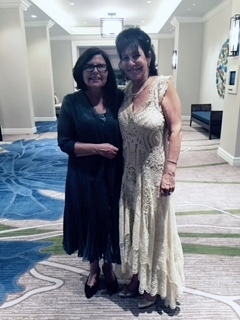
At the wedding with Mae

In her 30s, she became a therapist, a natural transition following years of providing counsel for her many friends. Oh, the hours she spent on the phone getting me through the many real and imagined crises in my life.

Her therapeutic work focused on bringing joy into the lives of the elderly, running bereavement workshops for children, and working in Miami for many years with cancer patients and their families. You can get a sense of her personality by watching an interview with her a few minutes into a documentary  about caring in the face of loss.

In a ballroom filled with white orchid centerpieces that almost reached to the ceiling, a 10-piece band played “I’ve Dreamed of You,” a song written by Ann Hampton Calloway, as John and Mae took their first dance.

I saw her again as the girl I knew: the first friend I made at Glades Junior High, Mae, my dance partner at our 7th grade fall dance. Now here she was floating in a lace gown she had sewn herself, surrounded by a lifetime’s collection of friends who loved her. What a privilege it is to be one of them.


Should You Really Ask The Tough Questions Before Getting Married?

I came across an article about 13 Questions to Ask Before Getting Married. Fortunately, it came too late. Exactly 25 years too late.
Because I read it just as I was celebrating my 25th wedding anniversary.
Relationship experts from the National Institute of Relationship Enhancement, the Couples Institute, and a divorce coach urge those contemplating the forever “I Dos” to step back first and answer some really tough questions such as:

Will you bail me out if I have debt? How often will you want sex now and in the future? Will you change diapers when we have children? Do you really like my parents?

Dear friends: Those of you who are single, recently married, divorced, or past the 10-year-mark, I suspect that you may have some strong reactions to this article and it’s worth reading through the full story.

My questions for the experts: Are you married? Did you ask these questions before you were married? And are you still married?

Yes, these are important questions and I believe these subjects should be discussed before marriage. But seriously, how many of us in the throes of infatuation and lust would answer truthfully? What is truth? Who can predict the future at such a time in our lives?

In my rear-mirror view, I know now I should have asked a few more questions. I needed far more clarity on the diaper issue, for instance, but on the major issues I put my trust in someone who shared my values. A few years ago, I knew I could count on my husband when my 90-year-old mother needed a step up to assisted living. No question about it.

So I guess I wonder how many of us would really take those vows if we fessed up to all those answers. Maybe a little bit of faith and eventual compromise really gets you through. But don’t ask me. I’m no expert.


What’s Wrong With The Media Diet Story?

First they took away my bagels. Then they threatened my breakfast. Now they’re trying to talk me into fasting.

By they you know who I mean: the journalists who jump on every research study, no matter how limited the results, no matter how flimsy, to tell us how to stay healthy, lose weight, and become better human beings. Ok, I made up the last one.

I’ve been on this media diet for years. In fact, I’m guilty of covering  stories like “The New Diet Pills.”  I’ve Slim-Fasted and Low-Carbed and at this point all I know is that skepticism is essential in a world gone kale crazy.

breakfast-991821_640

Here’s what I’ve told my students about understanding research:

Go deeper and link to the research article. If the journal is behind a paywall, you can still read the abstract.

Check for potential bias and conflicts of interest. Researchers must disclose their relationships with the industry. Ask who funded the study. Is it the National Kale Foundation touting the benefits of kale? OK, you know I hate kale, but it doesn’t always mean that the study is biased. Still, it’s important to know when evaluating the study.

Next, look at the study methods. If it’s a sleep study, did people self-report their snooze habits or were they observed in controlled environments?

When it comes to that fasting study, did they study mice, men or women? Which one are you?

Was it a longitudinal study – done over many years with many participants – or a limited study that included a small group of people in an obscure part of the world?

How significant is this? Do these findings replicate a previous study? Or do the experts say it’s promising or needs further study?

Then, look in the mirror and ask: Is this relevant for me?

My mirror said: “Healthy overweight friend, you need some scrambled eggs for breakfast or else you’ll get dizzy and fall over.”

But hey, feel free to fast if it makes you happy.

As for me, I’m waiting for the breakthrough study that finally reveals that bagels lead to a long and happy life.

What I Teach My Students About Study Abroad

I’m really getting hungry for one of those crepes oozing with chocolate that they sell near the Notre- Dame Cathedral in Paris. I’m dreaming about a perfectly cloudless day at the Acropolis in Greece, my navy espadrilles covered in dust. Continue reading “What I Teach My Students About Study Abroad”

Are We Getting Smarter About Working Out?

On the treadmill yesterday, going nowhere at 3.4 miles per hour, I was thinking about the ages and stages of my workout/ life balance. I know women my age who absolutely live for the gym, who tell me how much I would love cycling class if only I would just try it. My workout goal is to get in, get out, and over to Starbucks for a Venti Decaf Iced Americano. No cycling required.

Watching the women in their 30s  to 70s around me, some on the elliptical, others running next to me, I was flashing back to my single 20s and early 30s – hanging out at the Downtown Athletic Club all sweaty doing aerobics in my black leotard and tights. exercise-969300_640 (2)

As a young mother, I moved on to an uptown club for sculpting classes and workouts with my first trainer. In my 40s, I landed at this all-female gym, a place with great childcare, where I could show up in sweatpants and oatmeal stains on my shirt, which is exactly what I did yesterday after dropping my son off at school.

About 10 minutes in, I was thinking about how much exercise we really need to stay healthy and alert as we age, and an image popped into my head. Researchers had put rats into cages with running wheels to discover the connections between the intensity of various workouts and the creation of new brain cells in the “mature brain.” Surprisingly, according to a recent article  about the research, almost all the rats seemed to gain some benefit, even those that were just “slowly skittering” about.

When I was done, I checked my stats: 1.2 miles, 100 calories; nothing to boast about but I still felt fine. Whatever the intensity, I was living at my own pace. Come springtime, I will be off the treadmill without feeling guilty, intensely happy to be out of the gym and back walking in the sunshine.

.

Why Work Friends Become Real Friends

Why do we still feel connected to some work friends from our past and not to others?

I thought about this yesterday when two random events brought this home to me and I realized I was closely linked to two women because sometimes colleagues become confidantes and real friends.

At Starbucks, I ran into Jean, a journalist I used to work with at The Sun in Baltimore.  After we hugged, we spent an hour catching up about our kids, our lives, and our current careers – in that order – because at this stage that’s how it usually goes. What I most remember during our time at The Sun many years ago was that as her star rose and mine fell, she remained loyal. It wasn’t the most political choice for her and I was grateful. As we were leaving Starbucks, we noticed another former colleague busy writing on his laptop. We didn’t stop,

Around 10 that evening when I scanned my Facebook feed, I was stunned to see a post from Charlyne, sharing that it was one of the worst days of her life. Her husband Carter had died at home with hospice care. We had started our careers as journalists at The Sun-Sentinel in Fort Lauderdale and then, as things often happened, she had come up to work at The Sun a year or two after I had.

There’s been a lot of conversation lately about the public/private disclosure of the most personal health information and Charlyne had chosen the private way. For years – and we had not seen each other for many years after she moved back to Florida – she has been one of my favorite Facebook friends, always congratulating me on life’s milestones and my family, and sharing great articles about journalism.

I woke up crying this morning thinking about Charlyne and the death of her husband. I woke up thinking about her friendship during my illness when I was 30 and single and trying to keep my illness private. I also remembered how thrilled I was when she met Carter. She deserved all the happiness in the world.

Real friends step outside the workplace. I think of Jean and Charlyne as two women who stood by me when I was vulnerable. They changed my life and made me believe that kindness could be found everywhere, even at work.


A Not-So-Funny Valentine’s Story

I was once so desperate to get the attention of a young man who dumped me that I created a poetry magazine just to publish my sad little Valentine’s Day poem.

Many Valentine’s Days have come and gone and none were as desperate as that one but those pathetic lines proved prophetic:

“Valentine’s Eve, no knights of desire…Caught up like a kite in the wind with too many trees in my path.”

Ok, folks, I was only 16.
Over the years I spent many more of those Valentine’s Days and Nights alone than with someone special.

love-673300_640

But things changed early in my coupledom with my husband as we sometimes went out to overpriced dinners and I received the $50-a- dozen-soon-to-be- wilting red roses. A night out – dinner, a sitter – could set us back a lot. I realized how lucky I was to be part of a couple and how much time I had wasted being sad when I was solo.

Yes, it’s the thought that counts and here’s my thought.

My Nordic prince, wherever you are: You were not worth poetry, not even my bad poetry. After I exposed myself and heard people laughing behind my back, I waited for any response. Even if I couldn’t win you back, I hoped to see some twinkle of recognition as you passed by and looked down from your lofty heights. Yet, I never knew what you thought. Only years later did someone tell me her story. Then I realized you were probably just making your way through the yearbook. I was only in the Fs. You had to hurry. It was midway through junior year and it was a long way to Z.

Is “Younger” The Best Fantasy on TV?

I am obsessed with “Younger,” the TV Land comedy about a 40-year-old divorced mother from NJ played by  Sutton Foster,  who passes herself off as a 26-year-old because that’s the only way she can get a job in NYC’s publishing world.

Let’s for a moment forget the most ridiculous aspects of the show: She has a best friend in Williamsburg, Brooklyn with extra room in a spacious loft; a thrift shop/hipster wardrobe that only a stylist could throw together; and, get this, an adoring twentyish tattoo-artist boyfriend.

OK, it’s all fantasyland, but there is also something of substance here that goes to the heart of how hard it can be for a woman to reclaim her career after she gets off the merry-go-round to care for her children. So many women I know – from 40 to 60 – are still trying to figure this out: How to balance career and family. Every woman’s story is different. I’ve tried it lots of ways – on and off the merry-go-round through three careers – but I never thought to lie about my age. How could I? I could never get away with it. There’s Facebook and yearbooks and everything else to give me away.

Although the show is mostly played for laughs – Liza Miller must be the only 40-year-old who doesn’t know what Twitter is when she starts her job – there are some ugly stereotypes. Her boss, Diana, a severely made-up, divorced (and possibly childless) woman in her 40s, is a bitch from old school drama, and one who stands in the way of Liza’s success. And the male head of the publishing house is crushing on Liza and ignoring age-appropriate women like her boss.

Yet, the show is clever, and as Emily Nussbaum, the TV critic for The New Yorker observes, “The goofy premise suggests an alternative view of the generation gap.”  So, it comes as no surprise when a few of my students tell me they’re watching “Younger,” too. Why?  It’s all about Hilary Duff; they grew up with her. Hilary plays the perky, ambitious Kelsey, who is loyal to her sometimes clueless colleague Liza.  And also cries on her shoulder whenever she screws up. Only a few years out of college, Kelsey is creating the successful life my students can only dream of. She’s already getting her own publishing imprint for millennials.

Perfect. “Younger” is a fantasy for mothers and their daughters.