
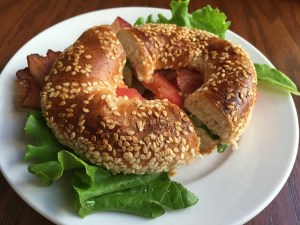
First they took away my bagels. Then they threatened my breakfast. Now they’re trying to talk me into fasting.
By they you know who I mean: the journalists who jump on every research study, no matter how limited the results, no matter how flimsy, to tell us how to stay healthy, lose weight, and become better human beings. Ok, I made up the last one.
I’ve been on this media diet for years. In fact, I’m guilty of covering stories like “The New Diet Pills.” I’ve Slim-Fasted and Low-Carbed and at this point all I know is that skepticism is essential in a world gone kale crazy.
Here’s what I’ve told my students about understanding research:
Go deeper and link to the research article. If the journal is behind a paywall, you can still read the abstract.
Check for potential bias and conflicts of interest. Researchers must disclose their relationships with the industry. Ask who funded the study. Is it the National Kale Foundation touting the benefits of kale? OK, you know I hate kale, but it doesn’t always mean that the study is biased. Still, it’s important to know when evaluating the study.
Next, look at the study methods. If it’s a sleep study, did people self-report their snooze habits or were they observed in controlled environments?
When it comes to that fasting study, did they study mice, men or women? Which one are you?
Was it a longitudinal study – done over many years with many participants – or a limited study that included a small group of people in an obscure part of the world?
How significant is this? Do these findings replicate a previous study? Or do the experts say it’s promising or needs further study?
Then, look in the mirror and ask: Is this relevant for me?
My mirror said: “Healthy overweight friend, you need some scrambled eggs for breakfast or else you’ll get dizzy and fall over.”
But hey, feel free to fast if it makes you happy.
As for me, I’m waiting for the breakthrough study that finally reveals that bagels lead to a long and happy life.
 twice30